Truths About Data Recovery Software


There may have been instances in your life or career where your day starts with a hard disk crash or a physical memory dump. If it hasn't happened to you yet, it can happen anytime and catch you completely unawares. It can be very frustrating to loose all the important data, those great presentations, client briefs, portfolio, 3 years of research etc. If you install data recovery software on your PC, then you can retrieve all the lost data. A computer is not a perfect machine and the fear of data loss is real. Hence, we are going to share some tips and useful information on data recovery software with you.

Why is Data Recovery Software important?

Data recovery is important because most of the data on your PC or Laptop is valuable. But what is data recovery? It is retrieval of almost all the data that has been accidentally deleted from your computer or has been erased due to a hard disk error, virus attack, or bad script. You can use DOS commands to retrieve data but it will be partial recovery only. So the best solution is to have data recovery software that can retrieve the full data or undo the loss.

Most of the data recovery software available in the market can recover data from corrupted file systems like Windows (FAT16, FAT32, NTFS, NTFS5), Unix (UFS, EAFS, HTFS, VxFS, FFS), Linux (Ext2, Ext3, JFS, ReiserFS), Apple Macintosh (HFS, HFS+) and Novell Netware (NWFS, Net386, NSS). The data recovery software can also recover data from corrupt access databases, corrupt zip files, word documents and excel files.

Which data recovery software should I use and why?

There are many firms who sell data recovery services, but there are many brands who sell data recovery software. At times, it can be difficult to decide, which product will satisfy your need or requirements completely. One such data recovery software is The Undelete 3.1.1. The salient points of the software are that it is easy-to-use and it can provide a powerful backup program for Windows 95/98ME/NT/2000/XP. This data recovery software can work with FTP, local networks and even CD-R/W. It is useful data recovery software that applies powerful algorithms and methods and it can recover files that have been damaged, lost or deleted due to a power supply failure, program bugs or virus attacks. The Undelete 3.1.1 data recovery software can recover files with extensions like DOC, PDF, RTF, XLS, MDB, PPT, Visio, CSV, HTML, TXT, CPP, PAS, EML, and INI. It can also recover audio and video files with extension MP3, WAV, AVI, WMA, MPG, MOV, and ASF.

There are also data recovery software's, which have specific use based on platforms, files and functions. You will find data recovery software that offers a range of file system utilities as well as data recovery service. These services enhance recovery of lost data due logical hard drive failures.

What should I look for in Data recovery software?

When you go out in the market to search for data recovery software, you should be able to compare various products based on five important features. These are:

- Feature Set

- Ease of Use/Installation

- Recovery Effectiveness

- Search Capabilities

- Help/Documentation

The bottom line is that basic data recovery software should be able to recover Compressed Files, and Encrypted Files, should provide email recovery, network recovery and create image files. It should be able to recover from the recycle bin, damaged files, power failure, Format Disk, changed, or deleted partition, disks with bad sectors etc. It should support file systems like NTFS5, NTFS, FAT32, FAT16, and FAT12 as well.

The author has 10+ years of experience in delivering relevant & innovative content and conceptualizing copy for storyboards, advertisements and other marketing vehicles. He is also a travel journalist and the creative head for RJ.

Home Improvement Loan


You've worked to build equity in your home. It is an investment in living as well as in savings, especially now that you've spent countless hours turning your house into a home. Maybe your family has grown in size, new costs such as college or weddings are on the horizon, or there's a big project you've been wanting to get to but don't necessarily have the money to complete.

With cheaper loan rates, contractors, and building materials, there are a number of reasons why investing in a home improvement loan might be a good idea.

Home Equity Loan Rates Are Low
You might have heard how rates are historically low right now. Or how home prices are rising again. It's all true. Especially when it comes to home equity loans. It's a good idea to contact your lender for the exact rates and to see which ones you might be eligible for. Ask if you qualify for a "relationship discount," which is for loyal customers who have account balances totaling a certain amount.

Cheaper Contractors
Contractors are still hungry for work despite the continued recovery of the housing market. By letting several contractors compete for your home improvement job, you can secure reduced pricing. Make sure you check reviews on websites to get the best quality at the lowest price.

Improvements Just for You
We tend to spend money to make most of our home improvements when preparing our home for someone else to live in. Making improvements shouldn't come just before selling. It should come when we can enjoy it ourselves. Why not tackle those big-ticket improvements and make those smaller upgrades while you are still living there and perhaps later down the line profit from the resale value? Put in hardwood floors, add an extra room, or do that backyard landscaping now.

Remember that Your Home Is An Investment
Think of taking on a new loan now as a way to save money later. The loan will help with repairs that you may otherwise not be able to afford. It can renovate, modify, and repair anything in or around your home. By doing so, you can increase the value of your home. When you do sell, that money comes right back to you.

Benefits of Home Improvement Loan
One benefit is that you do not have to use your home equity because a home improvement loan does not require you to do so. There is less processing time, fixed interest rates and low monthly payments that can be paid with 3 to 5 years. Interest is tax-deductible on loans of up to $100,000. Just make sure you check out every option and what types of loans offers the best deal.

Student Loans Your Educational Dreams

Do you know what's soaring and trying to touch the sky? The cost of education. Evidently there arises a need for student loans. There is no doubt there are scholarships and grants but they do not always make sure that the cost of education is paid for. 64% of students borrow loans for their educational needs. Student loans can actually help you pursue dreams especially if they are build on a platform called education.

Many people borrow money for various things like car, home, vacation etc that they can't pay for right away. Student loans are just one of the ways to fund education if it is expensive for your budget. If money is not available, this of course can happen with any student. Under any circumstance it is better to take student loans rather than drop the idea of studying further. Financial institutions are readily offering loans to young students.

Lenders are frequently offering student loans. But students are usually young people with little or no credit history. Then why would a lender associate himself with a credit history that is not promising. This is because most student loans are guaranteed by government. For students, Student loans are a cheaper option than any other money borrowing method.

You must have heard that before but borrowing money outside your capacity is not advisable. Same is true for student loans. Try to borrow as much as you need. And look for alternatives and work off campus if you need extra cash. Make sure you have worn out all scholarship opportunities before you apply for student loan. Most lenders will give you the full financial picture of the student loan but see that you do understand all the terms of student loans before you apply.

Qualifications for student loans are based on the income of student leaner, in case of an adult learner and on parent's income if you are dependent on them. Student loans are not only meant to pay for tuition fee only but also any additional expenses. Student loans will provide for board and room, books, computer and even student travel. Depending on your circumstances the student loans can be extended to fit your requirements.

Repayment of student loans is an obvious effect. Start paying back student loans as soon as possible. If you are already planning repayment - congratulations - you are ahead of most people in financial matters. Try to start repaying student loans as soon as possible. If you have other unpaid debts then start with the loan that has the highest interest rates. If your circumstances change - if you want to payback early or in case you can't make repayments you should immediately contact your lender. You repayments will be rescheduled in order to avoid paying more. There are detailed provisions to make repayments in case you become permanently disabled, or if you want to leave the country after completing education.

Student loans are low interest rates loans. The beginning of the year term 2004-5 started with historically low interest rates. Even with a recent increase in interest rate, student loans are a low cost bargain. Student loans lender can help you in calculations, in case you want to estimate when you would like to repay the loan. You take a free quote for student loans from various sites and then compare. Shop around and look for student loans lender that speaks best to your requirements.

Job hunting is becoming competitive by each passing day. There are so many people applying for one job that the one who has more knowledge, experience will find a place to settle. Higher paying jobs entail university backed education. University education in both public and private colleges is undoubtedly expensive but you will be reaping benefits throughout your life. This makes student loans a genuine investment for a lifetime.

Maria smith has not been writing articles from the beginning but the increase in perplexing loans information has urged her to write on different loans types. So she writes in a way that is logical, comprehensive, and understandably meant to cater to the need of general public who is left breathless while searching for loans.

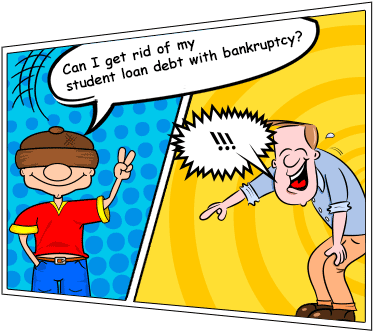
Bankrupt Your Student Loans

Everyone knows that you cannot bankrupt student loans. Search the web with the
keywords "bankruptcy" and "student loans" and you get either many listings for
lending institutions trying to get you to take out another loan, or you see articles
telling you that it is virtually impossible to bankrupt your student loans except
under the condition of "undue hardship"-- and then they fail to tell you anything
how to go about proving the condition. How frustrating!

Below is a summary of the salient points given in Bankrupt Your Student Loans and
Other Discharge Strategies by Chuck Stewart, Ph.D. (ISBN 0-9764154-5-3). Here is
an author who has been through the process, successfully bankrupting $54,000 in
student loans, and has written a clear, step-by-step, instruction manual to help
other honest debtors in their efforts to have their student loans discharged through
bankruptcy or Compromise or Write-Off.

The bankruptcy courts originally treated student loans the same as any other
unsecured debt. Student loans could be listed in a Chapter 7 filing and fully
discharged. However, in 1976 Congress modified the Higher Education Act of 1965
and required student loans to be nondischargeable unless: (a) the debt first became
due more than 5 years before the date of filing of the bankruptcy, or, (b) failure to
discharge the debt would cause "undue hardship" to the debtor or to dependents of
the debtor. In 1990, Congress extended the 5 year rule to 7 years and eventually
eliminated the time limit altogether in 1998. Thus, the only option debtors
currently have for bankrupting their student loans under 11 U.S.C.A. Bankruptcy
Reform Act (1998) §523(a)(8) is to prove repaying their student loans would cause
an "undue hardship."

"Undue Hardship" Analysis

Unfortunately, Congress failed to define the term "undue hardship." A review of the
discussion and debate by the legislature regarding the education amendment is
unrevealing as to the meaning of undue hardship. Thus, it has been left up to the
courts to determine its meaning. Aggressive defense by Department of Education
attorneys has influenced the court to a decidedly rigid interpretation. In general, for
a debtor to qualify for an undue hardship discharge of student loan debt, the debtor
must be living at, or below, the Federal Poverty Guideline and have no hope for
increased future income substantial enough to make payments on the loans.

Over the past quarter-century, courts have developed many tests to determine the
existence of undue hardship. The leading test used in most court is the Brunner
Test. Other tests include the Bryant Poverty Test, Totality of the Circumstances
Test, and the Johnson Test. A review of these tests locate some common
characteristics used by courts to determine undue hardship. These include:

Characteristic A. An evaluation of the debtor's current living condition and the
impact that has on the ability to repay the loan while maintaining a "minimal living"
standard.

Characteristic B. The debtor's future prospects for repaying the loan.

Characteristic C. Evaluate whether or not the debtor demonstrated good faith during
loan repayment.

There are two steps involved to demonstrate Characteristic A--

1. Every court reviews the debtor's current living condition and evaluates it against
the Federal Poverty Guidelines. Debtors with incomes above poverty will be
scrutinized by the courts to assure all expenses are "minimized." Expenditures will
be compared to an "idealized" debtor of similar situation but at the official poverty
level.

2. Once the court is satisfied the debtor has minimized living expenses, the court
evaluates whether repaying the student loans will push the debtor down to or below
the poverty level.

Characteristic B is impossible to predict. Courts have recognized the folly in trying
to predict future income, but it has not stopped them from including it in their
analysis. Courts have considered many factors that may affect future earnings
including personal limitations such as: (1) medical limitations, (2) support of
dependents (and their medical conditions, if applicable), and (3) lack of useable job
skills. Courts have also considered some external factors such as age
discrimination (for debtors over age 50), having been labeled a whistleblower, and
other social and cultural factors that affect the ability to obtain gainful employment.

Congress was most concerned with debtors who seemingly "defrauded" the
government by bankrupting their student loans soon after graduation. To reinforce
that concern, courts want debtors to demonstrate "good faith" attempts at repaying
student loans. Characteristic C, Good Faith, means that the debtor must show that
he or she made payments on student loans whenever his or her income was above
the poverty level, or, when there was insufficient income, he or she obtain
deferments or forbearances to keep the loan in good standing.

Income Contingency Repayment (ICR) Plan

Even if a debtor clearly demonstrates that the undue hardship analysis applies to his
or her case, the Income Contingency Repayment (ICR) Plan may unravel the case.
The ICR allows student loan repayment to increase or decrease according to the
income of the debtor. As such, if the debtor's income is below the Federal Poverty
Guideline, then the payment drops to zero. The plan lasts for 25 years and any
outstanding debt is discharge. However, the loan discharged amount is treated as
income by the IRS and income taxes will be due.

It is often stated by Department of Education attorneys that ICR makes it impossible
for debtors to discharge their student loans in bankruptcy. They contend that
anyone can make "zero dollar" payments, thus negating the undue hardship
exception of §523(a)(8). In many cases this is true. But for some debtors the ICR is
inappropriate. For example, imagine being 65 year or older living on SSI or on a
fixed income and then a large tax liability descends upon you for debt discharged at
the end of an ICR plan. That would place an undue hardship upon you. In fact, the
ICR is really inappropriate for anyone over the age of 40 because of the tax liability
at the end of the repayment period.

Regardless, debtors planning an adversary proceeding must prepare a robust
response to the Income Contingency Repayment Plan.

Filing the Bankruptcy and Adversary Proceeding

Student loans are listed in the Chapter 7 bankruptcy as one of the outstanding
debts held by the debtor. The debtor must then file an Adversary Proceeding in
conjunction with the Chapter 7 bankruptcy case within 60 days of the meeting with
the creditors. The adversary proceeding is against the Department of Education (or
other guarantee lender) and asks the court to determine if the "undue hardship"
clause applies. If the court decides §523(a)(8) applies to the case, then the student
loans are discharged through the Chapter 7 bankruptcy.

There is research to show that debtors who file their own Chapter 7 bankruptcy and
adversary proceeding prevail more often than if an attorney is used. Most attorneys
will not touch an adversary proceeding on student loans, and those that do, want at
least $5,000 up front with additional high hourly fees. You know your situation
best and it is suggested that you try to do this yourself. Even if you retain an
attorney, you will have to perform most of the financial research needed to prove
undue hardship. If you do file your own case, you may want to retain an attorney
or paralegal to help with some of the steps, forms, or language.

Here is where strategy comes into play. You really do not want to go to trial. In a
majority of cases, the debtor loses. In Bankrupt Your Student Loans and Other
Discharge Strategies, a chapter is devoted to an analysis of court cases. Often
courts give irrational responses and rule against debtors with clear cases of
hardship. Most courts analyze the debtor at the Federal Poverty Level whereas a
minority of courts performs the same analysis at a middle class income level.
Because Congress failed to clearly define "undue hardship," the courts have ruled all
over the place; and there is no consistency even between courts using the same
test.

The better tactic is to settle out of court with the Department of Education or
renegotiate the loan and stipulate that to the court. For example, you could
convince the Department of Education to accept 10 cents on the dollar as banks
often do with bad debt. Say a $60,000 loan is reduced to $6,000 paid over 5 years
(i.e., $50/month) with the remaining $54,000 discharged through the Chapter 7
bankruptcy. By discharging the debt through bankruptcy, there is no income
reported to the IRS with no resulting income tax. You and the Department of
Education create a Stipulation to the new repayment plan and submits it to the court
for approval without trial.

Debtors need to prepare like they are going to trial. Each of the Characteristics and
ICR discussed above must be addressed in full. It is not difficult work, just detailed
and tedious. It is advisable to create worksheets to systematically organize financial
details and write, in your own words, responses to each item. Research will be
needed to obtain current financial guidelines for the Federal Poverty Level and
typical expenditures for similarly situated debtors reported by the IRS. This
research helps to establish that you have not been negligent in your spending.
Bankrupt Your Student Loans and Other Discharge Strategies has created a
systematic approach to proving "undue hardship" with the use of worksheets,
sample forms, and extensive Appendix. By gathering all these materials together,
you will be able to aggressively negotiate with the Department of Education before
the trial. Hopefully, you will succeed and avoid a judge making the final decision.

It is impossible to write in general terms about how the adversary proceeding will
proceed. Each court is different and each case is different. However, like with other
civil complaints, there are usually the following steps:

o Filing the Complaint with Proof of Service

o Status Hearing

o Mediation

o Pre-Trial Hearing

o Trial

It is before the Mediation that you present your case to the Department of
Education. This is your opportunity to try and renegotiate your loan: including
having it completely discharged. More often than not, the attorney for the
Department of Education will play hardball citing the ICR as the reason you cannot
prevail with the undue hardship argument. You continue to negotiate with the
Department of Education after the Mediation and address those questions that came
up during the Mediation. In many cases, they will accept the offer if it is reasonable
rather than risk losing at Trial.

Even in situations where debtors do not file bankruptcy, there is the opportunity to
have student loans discharged through the little known processes of Compromise
or Write-Off. Instead of filing suit and having the case decided at trial, the debtor
negotiates directly with the Department of Education to discharge the loan. Why
would they do this? It costs money to keep dead loans in the system. Also, there
are government directives allowing the Department to discharge loans through
Compromise or Write-Off. Regardless if a bankruptcy or Compromise or Write-Off
is planned, the process of proving "undue hardship" remains the same.


Affordable Drug Rehab

Drug abusers are out of control. Drug abusers need help to get to detox and rehab. So why do family members wait for their loved ones to take themselves to rehab?

Often family members say, "He doesn't want help", or "She has to want it first".

But how do drug abusers or alcoholics get to wanting help? The first basic steps to getting them to accepting help are unknown or not taken by family members of drug abusers. Here are those missing steps to recovery.

Drug & alcohol abusers make issues about needing help and going to rehab. Getting an addicted loved one to accept help for problems with drugs is possible, if you know the steps to take. Working through conflicts with help speeds getting someone to recovery.

What is help?

Help is assistance, benefit, cooperation, aid, nurture, etc. Good help requires good control.

A person with ongoing drug or alcohol abuse issues has failed to help themselves. These losses can add up. Now they may believe help is not even possible. Failure = failed help.

First Five Steps To Drug & Alcohol Rehab That Works

First: are you offering Band-Aids instead of Intensive Care? If so, the seriousness of drug abuse and underlying actual problem has not been confronted and failure was inevitable.

Some people have even been instructed not to call a rehab center for a loved one suffering with an addiction. They somehow expect a miracle. Here's the truth: miracles occur in rehab and detox centers. Waiting for a miracle before rehab is waisting opportunities.

Intelligent planning and action will get you that miracle faster than idle hope.

Successful rehab centers' staff works with individuals to locate underlying and unhandled problems in living. Finding and handling actual problems is worth a great deal. When that is done, real help gets delivered and the cause of addiction ends. Confronting and being encouraged to deal with drug and alcohol abuse and real life requires extra help from others, new skills and abilities.

Second: Sometimes, the family needs to be brought on board, so that everyone is on the same playing field, helping the addict to recovery. By the way, enabling drug addicts by paying their debts and rent isn't help. Listening and learning more about intervention (bottom link) will move you forward in your understanding of addiction and intervention.

Third: Sometimes one has to start at the most basic level of understanding before getting the person to consider they have a problem and give a commitment to rehab. The easiest way to breach drug abuse with another is to suggest they really cut back or quit alcohol or drug use or read our web page or ask how much money they are spending on drugs & alcohol per week.

Do you see that your actions are being required here? These are action you take. Nowhere do I say, 'wait for the addict to ask for treatment or help'.

Forth: If they are willing to accept help today they will require assistance in getting to an effective drug detox and rehab program. You'll probably have to take them to rehab and help with admittance. Many of the detox and rehab centers I know of cost money and addicts and money aren't usually together for very long.

Fifth: If you've been struggling with an addict's denials, realize that you've been misapplying your intervention attempts. You are probably trying to do the job of a trained professional interventionist, and you haven't been getting the results required.

You Can Learn To Help Save An Addicted Loved One

Trained professional interventionists can successfully getting a person accepting help. But, if hiring a professional is not financially possible you will need to learn everything you can about intervention. We've solved that problem for you. I've worked with many interventionists and the process of getting someone to rehab is something YOU can lean.

So, help addicts get to recovery by assisting them to take their next steps. Insist they follow through with those efforts by finding detox and rehab programs that deliver up on what they promise. That means the rehab program produces results -- drug-free productive people who contribute to their families and society.

The first 5 steps to rehab require your assistance, then miracles can occur.

Do you need to learn more about getting an addict to rehab? Or, find out how to evaluate a good rehab program?

Subscribe to our free newsletter giving our Latest Discoveries about intervention and get the help you need, go to: Give Them Help

Tibor A. Palatinus, CCDC, is the Director of a Drug / Alcohol Detox and Rehab Consultancy which specializes in Referring Clients to Drug-free Detox and Rehab Programs which End Addiction for Life.

What to Expect From an Alcohol Rehab

Before joining into any alcohol rehab program, you must look for certain aspects that the alcohol rehab should have. If someone in your family is addicted to alcohol and you are looking for a good alcohol rehab, then from the beginning itself, make sure you know what you should expect from a good alcohol rehab. Different alcohol rehabs will have different kind of treatments and rules and hence you cannot generalize the format of alcohol rehab by visiting just one or two alcohol rehabs.

You need to check the programs of each of these alcohol rehab centers in minute detail to understand how they are implemented. This also helps you in knowing which kind of program you must use and will be the most suitable for the needs of the patient. These following points will help you when it comes to selecting a good rehab program.

1. Whichever alcohol rehab you are looking, make sure that you understand what kind of treatment they will provide. This is because almost every rehab center has a different kind of program and it becomes absolutely essential for you to check out that program and make sure that the patient for whom you are considering the treatment will be comfortable with the program. Try to understand each and every aspect of the treatment program given by the alcohol rehab center.

2. Make sure that the program is suitable for the needs of the patient. For this read all the possible information about the rehab in their official website. All the important aspects about the treatment center will be mentioned on the websites and hence do read them carefully.

3. Also check all the facilities offered at the alcohol rehab. The nursing care is one example. Know the kind of care given at the alcohol rehab as some rehab give 24 hour care while others don't.

4. Also the detox facility given by the alcohol rehab should be checked properly. Most alcohol rehabs have detox program in them but few don't have it and hence make sure the alcohol rehab you are choosing has it or not.

5. If you will not check the alcohol rehab for their detox program, then you might have to adjust when the rehab will send you to some other center for detox treatment and this will be inconvenient for you.

6. The alcohol rehab center should also be able to offer the patient a proper aftercare. The aftercare program is also equally important as the main treatment and hence it cannot be overlooked.

7. Be sure what kind of medications will be given to the patient throughout the treatment process. Some alcohol rehabs offer holistic treatment programs while some follows the traditional format. In some alcohol rehabs the focus will be on aromatherapy and acupressure while some will give medications and relaxation therapies. Make it a point to know what the patient will like and then select the one which has that kind of treatment option.

8. It is better to go for those alcohol rehabs which offer intervention programs. Interventions will guide you thought the treatment program and will be a major help for you and your patient. Not all the alcohol rehabs offer intervention programs and hence choose carefully.

9. It is better to talk with the interventionist and make a proper plan for your patient and with their guidance things will really become smooth for you.

10. Keeping all the above points in mind while choosing the rehab will definitely be beneficial in long run.

The best source to gather all these information about the rehab will be the Internet. There is a lot of information over the Internet. You will also be able to read the various aspects of the alcohol rehab in the websites FAQs section and About US section. You can contact them via email or by calling them to know more about them. If you know a particular alcohol rehab in your local area, then make it a point and visit it before selecting it.

There are various alcohol rehabs all over the world. If you are not satisfied with the facilities provided in your local alcohol rehab center then you can even try out alcohol rehab centers in some other states. The three basic steps in the alcohol rehab treatment will be same in all these alcohol rehabs but there will be some minor differences over the medications given by them. The main programs that an alcohol rehab should offer are intervention, detoxification and rehabilitation.


External Hard Drive Data Recovery


There are a number of ways to store data. You can store the files on hard drives, removable disks, DVDs or CDs, just to mention a few. However, contrary to the popular belief, no matter how these storage products might be, any electronic or mechanical device is subject to break down. No matter how new or old the device is, it can fail to function normally, and there's nothing you can do to avoid it.

Given that fact, a hard drive failure is then very common and there are many non-failure related causes of lost data, including accidental file deletion, as well as fire and water damage. If for instance, you are using a normal method of retrieving data which only fails, an external hard drive data recovery is perhaps the process that may suit your data recovery needs.

In the simplest terms, external hard drive data recovery refers to the process of recovering data from external hard drives like USB or Firewire when the data is no longer accessible through normal means. In some case, the external hard drive data recovery can be a simple process, but the truth of the matter is, external hard drive data recovery may require exhaustive and detailed work just to recover the lost data. But, again, just like the normal methods, external hard drive data recovery involves the same general process for salvaging the inaccessible files.

Usually, what takes place before the actual external hard drive data recovery is the evaluation process. The external hard drive is then evaluated and the external hard drive data recovery experts will provide an initial determination of the extent of the damage, as well as the potential for external hard drive data recovery, and the work involved to save the data needed. Note, however, that some external hard drive data recovery companies today charge fees for the evaluation of the external hard drives. But there are some that offer the external hard drive data recovery evaluation process for free.

In addition to the evaluation, it is usual for every external hard drive data recovery company to conduct an estimation of the entire work that will be involved. Aside from that, the amount of data to be recovered as well as the steps to be taken and the cost of the external hard drive data recovery service are commonly considered. This is the reason that almost all of the companies offering external hard drive data recovery offer quotes of what it will really cost to get your data back.

Once the evaluation and estimate are done, the experts offering the external hard drive data recovery service will usually wait for you approval to proceed with the actual external hard drive data recovery. They won't proceed with the recovery process unless you have given your approval. And, once the approval is made the external hard drive data recovery then begins, and the company works their best just to return the important files back to you. What is nice to know about most of the external hard drive data recovery services is that they even repair the damaged hard drive. If all else are settled, the restored data will of course be returned to you on media of your choice as soon as possible.


Student Loan Forgiveness

Did you know that there are numerous programs available that will actually pay off all or part of your college loans? Student loan forgiveness isn't a myth. Many of these programs aren't widely advertised and most people who are eligible don't even realize that they qualify to have thousands of dollars wiped off the balance of their educational loans.

Student Loan Forgiveness for Teachers

The Teacher Loan Forgiveness Program will repay up to $17,500 toward college loans for qualified teachers. Full time teachers with an outstanding FFEL or Direct loan balance on or after October 1998 qualify for $5,000 worth of college loan repayment after 5 consecutive years of service.

Student loan forgiveness at the increased amount of $17,500 is available to qualified borrowers who teach full time in the field of mathematics or science at an eligible secondary school or who provide special education to students with disabilities.

To learn more or to apply for this student loan forgiveness program for teachers, visit:
http://studentaid.ed.gov/PORTALSWebApp/students/english/cancelperk.jsp?tab=repaying

Student Loan Forgiveness for Non-Profit Child or Family Services Agency Employees

In an effort to attract and retain more highly trained early childcare professionals, the federal government has developed programs to forgive up to 100% of the college loan balance for individuals at eligible centers.

To qualify for this student loan forgiveness program, borrowers must hold a degree in early childhood education and work full-time for 2 years at a qualified facility where at least 70% of the children receiving care come from families that earn less
than 85% of the state median household income.

To learn more, call the Child Care Provider Loan Forgiveness support desk at 1-888-562-7002 or visit http://www.studentaid.ed.gov/students/attachments/siteresources/childcareinfo.pdf

Student Loan Forgiveness for Law Enforcement Officials

Protect and serve the community and the government will do the same for your budget by repaying your college loans for you. Full time law enforcement or correction officers are eligible to have their loans paid off by the government at a rate of 15%per year for the first 2 years of service, 20% for the 3rd and 4th year, and 30% for their fifth year.

Student Loan Forgiveness for Nurses and Medical Technicians

Several generous student loan forgiveness programs are available for physicians and RN's who practice in areas that lack adequate medical care.

The National Heath Services Corps will repay up to $35,000 per year of service for qualified individuals. To learn more and download application forms, visit [http://nhsc.bhpr.hrsa.gov/applications/lrp_ca.asp]

The Nursing Education Loan Repayment Program (NELRP) repays up to 60% of your college loan balance for those who serve at least 2 years in critical shortage facilities. To learn details about eligibility and to download application forms, visit
http://bhpr.hrsa.gov/nursing/loanrepay.htm

Student Loan Forgiveness for Armed Forces

The government shows their appreciation of those who serve and protect with a variety of student loan forgiveness programs for the military. The Armed Forces Forgiveness Program pays off up to $2,500 in college loan debt to borrowers who served between September 11th 2001 and June 30, 2006.

The National Guard offers its own student loan forgiveness program, paying off up to $10,000 worth of college loan debt for each qualified person. For more information call 1-800-GO-GUARD.

Student Loan Forgiveness for Volunteer Work

Serving in the Peace Corps, Americorps, or Volunteers in Service to America (VISTA) all qualify you for college loan forgiveness programs in various amounts.

Peace Corps: Time spent volunteering for the Peace Corps pays in more ways than good feelings. Volunteers receive 15% of their Stafford, Perkins, and Consolidation loans paid for each year of service up to 70% of the college loan amount. To learn more about this student loan forgiveness opportunity call 1-800-424-8580.

Americorps, the domestic arm of the Peace Corps, awards volunteers $4,725 to apply toward their outstanding college loans after one year of service. To learn more call 1-800-942-2677.

VISTA (Volunteers in Service to America): Volunteer 1700 hours for one of the many organizations across the country focused on eradicating hunger, homelessness, poverty, and illiteracy and have up to $4725 wiped off your college balance. To learn more call 1-800-942-2677.

Student Loan Forgiveness for Head Start Staff

Those who volunteer for their state's Head Start program not only help children from low income families prepare for kindergarten, they are also granted full or partial college loan forgiveness.

The state rewards its Head Start teachers and administrators by canceling 15% of their college loan balance for each year of service up to 100% of the balance. To learn more visit: [http://www2.acf.dhhs.gov/programs/hsb/]

Student Loan Forgiveness for Providers of Intervention Services for the Disabled

The government will pay your Perkins loan in full if you provide full time services designed to aid disabled infants or toddlers who have physical, cognitive, communicative, social, emotional, or adaptive needs. Qualified programs can operate from an in-home setting or outside facility providing the program conforms to the requirements of the Individuals with Disabilities Education Act. To learn more about this student loan forgiveness program, contact your loan provider.

Find More Resources that Offer Student Loan Forgiveness Programs

Even more programs exist at the state or county government level or through industry-specific organizations. Inquire with the human resources department of your employer or groups that you volunteer for or are considering joining. Be sure to bookmark this page of resources or pass it along to a friend or colleague. You may just find a way to save yourself or someone you know a few thousand dollars!

ScholarPoint Financial, Inc. is a national online consumer lending company specializing in student loans. We believe in combining state-of-the-art technology with world class service to help students and parents easily gain access to data, become informed, and enjoy the process of obtaining a college loan.


Florida Drug Rehab Choices

Florida is a beautiful state with lots of sandy beaches and beautiful warm weather. No wonder it's the number one choice for people who are considering where to go to drug rehab , addiction treatment or alcohol rehab. Although drug rehab is a lot of work and you are not there to "hang out" at the beach, you do get the opportunity to enjoy all that going to drug rehab in Florida has to offer.

Why a Florida Drug Rehab or Alcohol Rehab

Florida has quite a few licensed drug rehab facilities in the state, and many use Florida's beautiful landscape to assist patients in their recovery from drug addiction and alcoholism. Most of the Florida drug rehab and alcohol rehab programs offer the same addiction treatment programs as drug rehab and alcohol rehab's in other parts of the country, however Florida has become a popular choice for those seeking a new environment and a new start. There are some perks for people who want to attend a drug rehab or alcohol rehab in Florida as well. You will find many of the addiction treatment services offered there are held outside. This provides the patient with an entirely different addiction treatment experience than just sitting in a closed room.

How to Choose a Florida Drug Rehab or Florida Alcohol Rehab

Since there are hundreds of different drug rehab programs and addiction treatment facilities in the state of Florida, if you are planning on attending or sending someone else there, take a close look at the drug rehab programs. Ask questions...

Does the drug rehab program have their own medical detox program?

Does the drug rehab program have a comprehensive family recovery component?

Does the drug rehab have the ability to treat dual diagnosis and relapse prevention?

If you are looking for a Florida drug rehab or Florida alcohol rehab go to www.recoveryconnection.org or call the national addiction treatment services helpline at 1-800-511-9225.

Jonathan Huttner is a partner in Lakeview Health Systems which specializes in the treatment of drug addiction, alcoholism and dual diagnosis. Lakeview also operates a GLBT addiction treatment component called Freedom Rings.

Cheap Data Recovery

The average computer user has only a vague understanding of how their data is stored. They know they have this "hard drive thingy" inside the computer and they know that's where their data is kept. That's about as far as it goes for most users. Many don't even know what a hard drive looks like.

However, when you are faced with data loss, you quickly learn a lot about hard drives. Not only do you begin to get an understanding about how complex they are, you also find out how expensive it can be to get your data back. At least once a day customers will ask "Why does it cost so much? I only paid $100 for my hard drive". Yes, data recovery can be that expensive. My answer is simply this, if you had a million dollars sitting in a $50 safe, and you couldn't get to it...does it really matter how much you paid for the safe? Data recovery should only be sought, if the value of the data exceeds the cost of the recovery.

Data Recovery Costs

On average a reputable data recovery company is going to charge anywhere from $400 to $700 for a logical hard drive recovery. A logical recovery is where there is damage to the file system, or partition table and the data becomes inaccessible. This can be caused by an accidental format, electrical issues, viruses, etc. In some cases physical issues with the drive can also cause this problem, especially if the drive has weak or degrading read/write heads. A logical recovery can typically be performed without having to make any repairs to the drive.

Physical recoveries can be priced all over the place. It really just depends on who you call. A physical recovery actually requires the hard drive to undergo some type of repair before the actual data recovery process can begin. In most cases a physical recovery entails swapping out the read/write heads, repairing the electronics or transplanting the platters. There are a handful of companies out there that are very skilled at performing this type of recovery. A word of caution though, for every one good company, there are probably five dozen others out there that will make the situation worse.

Budgeting Your Data Recovery

If data recovery is not in your budget now, and the data is not time sensitive, one thing you can do is just keep the drive stored somewhere safe. This gives you time to save up money in order to have a competent lab recover the data for you. You should look for a lab that offers free evaluations, and will give you a firm quote in writing before they start the recovery process. That way if the price ends up being too high you can just have the drive shipped back to you, and you would know the exact amount you would need to save up in order to get the recovery done at a later date. It's not going to hurt the drive, or make the chances of a recovery any less possible if the drive is stored somewhere while you save up to have it recovered. Keep in mind that any reputable company will not charge you anything if the data is unrecoverable. This is one critical thing to verify with any company you contact. Consumers can be caught paying a lot of money for data recovery services, and still not have their data when it's done. It's not uncommon for some companies to charge $150 to $300 for parts, lab fees, attempt fees, or whatever they want to call it even on cases where the data is not recoverable.

Things You Can Do Yourself

If you suspect your hard drive has failed there are a couple of things you can try on your own to avoid the costs of shipping the drive to a data recovery lab. First of all, if the drive is clicking, knocking, or making any unusual noises, you are out of options to try yourself. Those cases definitely need professional data recovery service. Regardless of what you read about putting drives in freezers, opening them up, or whatever, anything you do in a case like this can only make the situation worse. If the drive makes any unusual noises at all, it's best to just immediately power down the drive.

If the drive sounds ok, you may want to try it in another computer. It could be an issue with your motherboard, or even the cabling in your computer. Make sure all connections are secure to the hard drive. If you don't know what to look for, see if you can find a family member who is knowledgeable with computers to help you.

If the drive is in an external enclosure, like a backup hard drive, and it no longer powers up, remove the drive from the enclosure. Check for signs of an electrical short. If it was severe enough, you will smell the burnt electronics. In a case like this, a data recovery professional would be needed. In most hard drives today, you can't simply replace damaged electronic boards from one hard drive to another. There is unique, adaptive information that is stored on various chips on those boards and the data won't be accessible without it.

If there are no obvious signs of physical damage to the drive, then you might want to find another computer or another hard drive enclosure and try the drive in that. It may have been an issue with the drive enclosure that prevented the drive from powering up. If it still has problems, then chances are you are going to need a data recovery professional help you.

Cheap Data Recovery

Try to avoid companies that price themselves too low. You wouldn't have brain surgery performed on you by the doctor who bid the least would you? In a way, it's the same thing with data recovery. Consumers don't realize how difficult data recovery actually is. Some of the information out there doesn't help, and will often times tempt users into trying to perform the procedures themselves. YouTube videos, even the ones that we have out there, one of which is titled Western Digital Head Swap, simplify the process and make it seem easy. Our videos were never intended to be instructional. They were meant to give our customers an overview of the process when we repair hard drives for data recovery. There is a lot more to data recovery than will ever be shown in a video. If the data is worth it, and many times our pictures, business files, and intellectual property is priceless, then it will be worth it to go with a company that you have confidence in. Not just some fly-by-night company who says they can do it for $199. Sometimes the parts alone can cost that much.

In closing, while data recovery can be expensive, cheap data recovery can cost you more in the long run. Do your homework, study the industry, and choose a company you feel comfortable with.

Hard Drive Data Recovery

Data recovery can be tedious. The good news is data recovery, more often than not, is still possible. Data recovery can be done in either two ways: by using data recovery software or data recovery services. Data recovery software can help you revive the data which you thought was lost. However, data recovery services can do more than that.

So what exactly is data recovery? Data recovery, according to the word sleuths and data recovery experts, is the process of salvaging deleted or inaccessible data stored on damaged media like magnetic disks and computer hard drives, optical devices, and tape cartridges. Many data recovery software programs and data recovery services are designed to help users retrieve their files at the event of a computer crash or viral infection.

How does data recovery work? The first step of the process of data recovery service usually involves evaluation to determine the extent of the data lost. After the prognosis, the data recovery experts and technicians would then proceed in "cloning" or copying the media into their systems. The actual data recovery process occurs when the technicians secure and extract the data from the copy of the damaged media.

Hardware and software teams A damaged media has the data locked within it and it is the job of highly experienced hardware and software engineers to unlock it. These two teams of data recovery experts work very closely together throughout the project, combining all their experiences in their respective fields to solve the problem quickly and surely.

For safety measures, hardware engineers access as much of the disk as they can to produce the copy which they then share with the software specialists. The bulk of the data recovery process lies on the software team as they are the ones who do the actual extraction using complicated software programs designed especially for data recovery work. The ensuing data are then filed and written onto a new, undamaged media.

Before engaging a hard drive recovery service to attempt data recovery, it pays to know what a hard drive and hard drive failure are. A hard drive is a stack of discs coated with thin layers of substrate and magnetic material. Hovering above the disc is the drive head. The discs create a slight breeze as they spin, creating a cushion of air for the head. The drive head, as a rule, never touches the discs unless something happens to that cushion of air beneath it. If however, the head touches the discs, it will drop through the magnetic layers and cut slashes into the surface of the discs. It grinds through the aluminum substrate and sprays dust from all three layers all over the discs. The result is hard drive failure.

Utilizing data recovery services from data recovery experts usually comes as a last resort. But they do not come cheap. Data recovery software like, say Symantec's, could cost something like $39.95. A data recovery expert could charge from $250 to $3,500 on their data recovery services.

Each data recovery service has a unique approach in solving the data recovery problem. But usually, the priority is to get the damaged drive running again. However, data recovery services cannot perform miracles. A massive head crash in the drive usually mean it's gone for good.


Rehab Alternatives

Please don't expect and use drug rehab, pharmaceutical rehab or alcohol rehab as a method of getting even with a loved one or user who's abusing drugs or addicted. Rehab is an alternative to justice.

Drug Rehab Alternative

Drug Rehab rewards people through better health, regained integrity and reuniting with family. These are benefits of drug rehab. Complete rehab is achieved through ending drug, pharmaceutical & alcohol dependency. Rehab means to bring back to good health and condition. A person who is suffering through a drug, pharmaceutical or alcohol rehab and not improving or getting better are not on track and not being rehabilitated. Regret and remorse are only necessary transition stages through to better states of recovery yet suffering isn't rehabilitating.

Breaking people down, scaring them straight, throwing them into jail is not rehabilitation. Harmful or threatening actions may get a person's attention, but threats won't rehabilitate people back to health. A carrot or hope for betterment and recovery steps attracts a drug abuser into treatment and rehabilitation.

Alternative Rehab

Alternative rehab programs focus on enticing a person back into living. A former drug abuser needs to want to live in reality to achieve recovery. Life in rehab should be safer and happier than the numbness of drugs, pharmaceuticals and alcohol. Rehab is the transitionairy training and recovery from living in the false reality of being drugged or drunk and into facing life and living in the real world.

Rehab Is An Alternative

The next question you may be asking is, "How will rehab rehabilitate a former drug, pharmaceutical or alcohol user back to health and happiness without drugs?" The easy and simple answer is through rehabilitation of course. Health, happiness and healing is accomplished through right action, proper care and rehab. Drugging, jailing and threatening people isn't rehab. Rehab is the alternative to how society punishes people for obviously wrong action. Rehab is the alternative to degradation and punishment. Make sure the carrot of rehab & recovery is always sweeter than than the stick is punishing.

Want to discover how drug, pharmaceutical and alcohol abusers got themselves locked into dependency on drugs?

Watch Alternative Drug Rehab

Tibor A. Palatinus, CCDC, is the Director of a Drug / Alcohol Detox and Rehab Consultancy which specializes in Referring Clients to Drug-free Detox and Rehab Programs which End Addiction for Life.


Government and Federal Student Loan Programs

If you are considering entering college in the near future you should be aware of the many different types of government and federal student loans. While many colleges do offer free student loan scholarships and there are various types of need-based financial aid and grants available; loans still make up the major portion of funding for the cost of education for most college students. Private student loans are also available; however the advantages of federal student loans usually far outweigh any benefits of private student loans; if you qualify to receive them.

Private college loans are credit based and may involve a co-signer from the students parent. You must qualify to receive a private student loan even though the loan program features are quite attractive. The National Student Loan Center or the NSLC offers many private low cost low rate college student loan programs. The NSLC also offers private as well as government student loans. An especially attractive student loan program offered by the NSLC, is the NSLC PLUS loan program; which gives parents of students the option to borrow up to 100% of their child's cost of education. This is nice because the cost of higher education institutions is blasting through the roof every year! Armed with this type of higher education financing, a college student can fund everything from room and board to books and just have to concentrate on studies.

Government and federal student loans allow college loans without a cosigner. They are non credit based student loans. Credit is not even looked at under federal college loan programs for students. Their will always be a student loan lien on the students credit until the college loan is finally paid.

Perkins Loan

One of the most common government and federal student loans is the Perkins loan. It comes with a low interest rate of only 5% and is awarded to both undergraduate and graduate students. There are no origination fees charged for this loan and it is paid back to the school because loan funds are issued directly from the school to the student from monies provided by the government. Take a look at the following facts regarding the Perkins Loan:

    Need based loan; only those students with exception financial need will qualify
    Able to borrow up to $4,000 for each year of undergraduate study and $6,000 for each year of graduate study.
    Loan limits are $20,000 for two years of undergraduate study and $40,000 for graduate school.

FFELP (Federal Family Education Loan Program)

This is also another common loan and features both subsidized and unsubsidized student loans. The difference between the two is that the government will pay for the interest of the student loan while the student is in school and during the grace period of a subsidized student loan while the student is responsible for the interest in an unsubsidized student loan. Additionally, students must display a financial need to qualify for a subsidized student loan while the unsubsidized student loan is non need based.

Federal Parent Loan for Undergraduate Students (PLUS)

This type of student loan is available to parents and guardians of dependent undergraduate students. Borrowers do not need to demonstrate financial need and may borrow up to the cost of attendance; minus any amount of financial aid that may be received. Loan funds are first applied to tuition and fees. This type of government and federal student loan has a variable interest rate.

For more information about government and federal student loans, please visit: http://www.studentloanwithoutcosigner.com

Obtaining a college loan without a cosigner is made possible with government sponsored loan programs. They are not credit based student loan programs. Private student loans are credit based and you must qualify based on your credit. Sometimes a cosigner is neccessary in these types of private loans. Higher education student loans can be obtained through these federal loan programs and also higher education scholarships can also be awarded if you take the time to fill out the proper forms. A federal grant for students is another free scholarship made available by the governement for college students. There are many different grants which anyone can receive if you fill out the student aid forms. This is the first step to take because colleges and universities are allocated certain grant amounts, once used up for that school year are gone.


Bad Credit Student Loans


The day you stop learning is the day when you start decreasing your rewards. Learning is a constructive effort - who knows it better than student. A student is a 'learner' himself. There is no terminal point to the potential of a student. Abridgement of finances is the last thing that must cast a shadow on your plans. It will be like an opportunity wasted for no fault of yours. It is just the beginning of your life being a student and you are plagued with concerns like paying for your education, books, room, computer etc. you open your book and you see payments. Is there a solution to it?

Pertaining to your experience as a student you might know there is no problem that does not have a solution. So the solution of your problem is - student loan. Paying for your college education with student loans is okay but what about bad credit. Perhaps there is one thing that cramps a student's efforts to find a good education more than anything else and that is bad credit. Before having any other degree you have acquired the one for bad credit. This bad credit tag seems to attach itself to your loans application and that too very promptly. However, bad credit student loans are offered to students previously, presently and will be offered in future also. Correspondingly, you can deduce that the opportunity is way beyond wasted.

Students with bad credit taking loans may not seem as a very positive exertion in the first instance. With bad credit already haunting you, you perhaps don't want to take a bad credit student loan. Many students are unable to pay for college education directly. It is unlikely that every person pursuing education has enough money for funding his education. Being in bad credit perhaps makes you even more suspicious of student loans. You might remark why get into financial aid procedure for education. It might happen that you cannot forage a sponsor or your parents cannot supervise your student expenses. You can't simply leave this to your parents.

Many people do not understand the meaning of bad credit or bad credit score. You must have accumulated bad credit without any knowledge. Late payments, arrears, a term used to describe a poor credit rating. Common practices that can damage a credit rating include making late payments, skipping payments, exceeding card limits or declaring bankruptcy. Bad credit can result in being denied credit. But that is passé. Bad credit student loans are abundant and processed keeping in mind the financial parameter and status of a person with bad credit. If you want to straighten out your bad credit situation, a bad credit student loan can promulgate establishing a good credit status.

In the current scenario bad credit has become synonymous with financial opportunities. Being a student you know how much can be achieved with an opportunity. Loan lenders are offering student loans even to people with bad credit. However, it is not all peaches and cream. Bad credit student loans come with an obvious detriment - higher rate of interest. Consequently, it is obligatory to ask the right questions in relation to bad credit student loans. As a student you need to be conversant about the information and paperwork in relation to bad credit student loan. Because the financial-aid package like bad credit student loan is borrowed with the student as the primary borrower, they are fully aware of the potential debt.

If you are still unsure about how to fill an application form or how to apply for bad credit student loan there is still a scope for learning. A student would know that there is always a scope for learning. The best time to get started with getting information about student loans for bad credit is your junior year in high school. Students can do research on various schools available to see what is offered. Taking a student loan unquestionably related to the course you want to apply for. This will facilitate the amount you require for your academic course. While applying bad credit student loan, you must be aware of the amount you need. Planning works like a foundation stone for bad credit student loans. And sticking to the plan makes your student loan acquisition easier than you assume. There are universities that require the students to pay the tuition fees immediately. A bad credit student loan will be particularly supportive in the given circumstances.

Any financial consultant will can divulge in detail over the benefits of research and inquiry while shopping for a bad credit student loan. And this is not without reason. High school counselors, college financial-aid offices and Web sites will encourage your effort at seeking a bad credit student loan. Making early contact with the requisite institution is strongly advocated. Students hunting for bad credit student loans should contact the top three schools of interest and talk to the financial-aid office and maybe the admissions office, and ask what is needed to apply. Make necessary inquiries so that you are clear when you are applying for the bad credit student loans. Make the office aware that you are an incoming freshman so that you are steered to the legitimate department.

A few more things are required to be stated in context of a bad credit student loan. Bad credit student loan is payable only after the student completes his education and starts earning a minimum amount. April 2005 has brought a new revision in the minimum amount. The minimum amount required to be earned by the contender of bad credit student loan has increased from £10000 to £15000. Conjointly, two significant terms relating to bad credit student loans are forbearance and deferment which will facilitate delay of repayment if you don't have money immediately after you have left the school. However, as I already said it is not all peaches and cream. It is not very easy to get a bad credit student loan. Lenders have the tendency to see students as loan borrowers because they are not into regular employment. Since you already have the qualification of bad credit it might serve as an overt deterrent. Moreover, some banks have fixed the minimum age required to student loans to 22. Usually this age is higher than that of average students.

Regardless of the obvious disadvantages, bad credit student loan is offered to students under both secured and unsecured alternative. Being a homeowner will nullify to a great extent you bad credit vibes while applying for bad credit student loan. Unsecured bad credit student loans will invite a higher rate of interest owing to the lack of security that is rendered in a secured bad credit student loan.

Statistics show that more than 80% of people want their children to go to college or get higher education. Yet not even half of them have taken any imperative steps. An imperative and certainly one of the constructive effort is student loan for bad credit. Every time you climb the ladder of education the list of provisions keeps getting bigger and better. 'Bigger and better' portends higher expenditure. Every student deserves education. If you sit back and contemplate, you will realize that a student has more potential than any other person. Somewhere, you already know. To restrict it by words like 'bad credit' is a mere insult to the possibilities of mankind. If you think the loan lenders don't realize it - there is a lot you need to get educated about. Bad credit is not an obstruction but stepping stone to what you are going to achieve. Make use of the probability called bad credit student loans to see the possibilities.


Finding the Right Mortgage Broker for You

In each state there are thousands of mortgage brokers. How do you know which one to choose so that you will end up at the closing table on time with the interest rate, loan terms and fees promised to you? Here are some tips and data that hopefully will give you the information and tools needed to find the right mortgage broker, how to work with them and to help minimize the risks before you get to the closing table.

First let's eliminate some of the ways borrowers typically choose a mortgage broker. This may just remove most of the problems before they occur.

How Not to Shop for a Mortgage

As a lot of people do, you could go to the Internet and call the first few mortgage brokers that pop up, check the local Sunday Real Estate Section to see who has the best rate, or call someone from out of the Yellow Pages. However these should be defined as ways NOT to shop for a mortgage:

Searching On-Line

Most every mortgage broker is listed on the Internet. While it is a great resource, it is not the best way to shop for a mortgage. It may be obvious to some, but just because a mortgage broker's Web site shows up high on search engine listings does not mean they have the lowest rates or have the best service or are even reputable. High search engine rankings do not speak to these factors, but rather to the fact that the webmaster who built the Web site probably spent hundreds of hours building and fine-tuning their site to show up on the Internet listings when you type in certain mortgage "keywords". Search engines do not rank listings by the quality or reputation of a broker but more by the amount of other similar Web sites that link to that Web site, the amount of visitors it receives, how much the broker may have paid to be listed there and many other factors.

Once I had a customer call me and say "You must be reputable as you showed up #1 in Google." Yes, I am reputable, and I do like to think we offer very good service and low rates, but that is not why my broker was listed at the top. (Number one out of over 275,000 listings for the term "atlanta mortgage".) It was because the webmaster spent hundreds of hours building and fine tuning all of the pages within the site to show up with high rankings.

There are many Web sites that list mortgage company's rates on-line. I don't put too much stock in sites that list these company's rates online. Typically mortgage brokers pay to be listed on those sties and some are "affiliate" sites. Which means they are charged a fee when the visitor goes to the link that was clicked on. To find out if you are on an "affiliate" site, click on the link it takes you to and examine the web address. If it has a code at the end of the domain name, such as "http://www.anybroker.com/source=2519" it is generally an affiliate. There is nothing wrong or illegal about this, just realize some of the sites may be biased by the companies that pay or give an incentive to be listed on their site.

Another tip is not to waste time in clicking on sponsored links. On Google they are listed in the right column, (and recently at the top of every page in a shaded box) while AOL's links are lightly colored boxes at the top and bottom of the page and on Yahoo they are listed in the column on the right side and at the bottom of the page in a colored box. As they name implies they are "sponsored" links which means to be listed the broker has paid to be there.

Be aware that if you complete a form on a mortgage Web site concerning wanting more information prepared to be flooded with calls or emails from mortgage brokers wanting your business. There are a lot of Web sites that are only "lead" sites. They get your information and then sell that information to mortgage brokers across the nation. Only submit information on the Web site of the mortgage broker that you know you will be working with.

The bottom line is the Internet is a great way to find out more about a mortgage broker that you are considering using but it may not be the best way to find one you can trust.

Choosing a Mortgage Broker Based Solely On Rate
The interest rate obtained on a mortgage is one of the most important factors of a loan, but it is not everything. There can be over 30 separate closing fees that can factor into the total cost of obtaining a mortgage loan.

Don't be fooled by brokers advertising that they have the lowest rates. Most mortgage brokers and lenders have about the same rate on comparable programs on any particular day. They may quote them with or without Loan Origination fees and/or Discount Points, which makes it even more confusing. When selecting a mortgage broker the interest rate is an important factor but let's take it a step further to get a better picture of the total cost to you.

Sometimes when a prospective client calls me asking "What's your rate?" I ask them what they would like 6%, 5% or even 4%. The fees to obtain such a low rate may be exorbitant, but we offer it. So again, rate isn't everything. It is the total cost that the borrower ends up paying that makes the difference.

You have probably seen mortgage brokers advertise rates at 1%. Do you really believe that 1% money is available? The answer is No. This is what the monthly payment is based. Don't be deceived by just rate.

The Liar's Rate Sheet

Another way some borrowers shop for a mortgage broker is by comparing rates in the Sunday Real Estate section of their local newspaper. In the industry this is referred to as the "Liar's Rate Sheet". Here is how it works. Mid-week the mortgage companies forward rates and APR (Annual Percentage Rate) to the newspaper for the different loan programs. They may quote the actual rate for that day or they may be quoting what they think it will be on Monday. All mortgage companies know you can't call them until the first business day of the week so they may hedge the rate a little to get the phone to ring on Monday. I am not suggesting that all or even a majority of the mortgage companies that list their rates in the newspaper do this. Most mortgage brokers and loan officers that I have met over the last 20 years are honest and ethical. But this is a very competitive business and there is a lot of money to be made on every loan.

Another flaw in the Liar's Rate Sheet is in the APR's that are listed. A simple definition of APR is, the true cost of the loan including certain designated closing costs. There are some loan officers that do not know how to calculate APR correctly. So do not base your decision on choosing a mortgage broker solely on the APR quoted.

Here is a sample of 10 recent rates and APR's quotes in a major metropolitan newspaper by local lenders and mortgage brokers: (These are based on $175,000 loan amount with 20% down payment, 30 year fixed rate loan.)

Note Rate APR Origination Fee Discount Points

5.875% 6.050% 0 1.90

6.000% 6.103% 0 0

6.125% 6.603% 1.00 .13

6.125% 6.270% 0.16 0

6.250% 6.122% 0 0

6.250% 6.305% 0 0

6.250% 6.425% 0 0

6.250% 6.624% 0 1.00

6.375% 6.289% 0 .75

6.375% 6.470% 0 00

If you were trying to make a decision as to what mortgage broker you may want to contact based upon the note rate (interest rate) or the APR you would not only be terribly confused, you would also be misled. The only way you can accurately compare rates and fees among mortgage brokers is with an accurate and complete Good Faith Estimate and complete Truth in Lending forms.

It is also important to remember that many, if not all of the mortgage companies and brokers listed typically pay to be listed there each week.

If you want a partial list of mortgage brokers in your city use the Sunday paper for that reason. Utilizing the phone book or Internet will give you a bigger list. If you want a full list go to your state's Web site that lists all licensed mortgage brokers in your state.

Where to Start

When you are looking for any type of professional service person, accountant, dentist, etc, who do you turn to? People typically ask the opinion of someone they trust, be it family, friends, neighbors, co-workers, attorney, accountant or other professionals. The referral method can also be used to help find a mortgage broker.

Make a list of 10 people (who have a mortgage) and ask the name of the broker they worked with. Be sure and get the name of the person they worked with. Keep in mind that service between one broker or loan officer and another can vary widely so you will want to contact that specific person, not just anyone in that broker. Also be sure to ask if they were happy with the rate and service they received.

Collect at least three names of loan officers or brokers or maybe even up to seven or eight. Why so many? Because it may have been a few months or years since your referral source last used this individual and it is possible that they have moved to a different company or even changed careers. In addition, not every mortgage broker is going to want to work with you concerning items that we are discussing. Also list any broker or loan officer that you have used in the past and were happy with.

A wise business man once told me. "Know who you are dealing with". Now that you have a preliminary list of names let's try to find out a little more about whom you are dealing with. To help with this I have put together two simple approaches:

1. Background checks

2. Making contact (Parts A and B).

Step 1 - Simple Background Checks

Don't worry, there is no need to hire a private investigator or do any "dumpster diving" to gain secret information. I do, however, suggest that you do a little investigative work. It should only take about 30 minutes and it will not cost you anything. In fact, it may save you a bundle of money and stress later in the process.

Visit the government Web site for the state in which the mortgage broker is located that you are researching. Locate the page that has a list of mortgage brokers or lenders. If the company you are researching is not listed they may be listed under a different name. Also you may be able to search by the individual or loan officer's name.

If they are listed on the State's Web site, it may also list how long the broker has been licensed (you should do business with them only if they have been in business for a minimum of two years), how many loans they have closed in the previous year, how many employees they have, and if they have had any consumer complaints made against them, administrative fines levied or regulatory orders (such as "cease and desist" orders) placed on them, any of their employees or broker. Be sure to search under the individual broker or loan officer's name, keeping in mind that some states do not license loan officers so that person may not be listed. Checking with the Better Business Bureau may give you some additional information but in my experience most mortgage brokers and lenders are not members of the BBB.

Find their Web site and read about them. Do they post their rates and update them daily? Do they offer informative articles or information? Read their bio's, Mission Statement and Privacy Policy to try to get a sense of what they are about, what they stand for and their vision of how they conduct their business. In addition, look for membership in professional associations, awards, etc. If they do not have a Web site I would not deal with them.

Check to see if they are a member of the National Association of Mortgage Brokers. http://www.namb.org. I highly recommend working only with a broker or loan officer that has such designation because it shows a higher degree of professionalism and dedication to the industry.

Another organization to check with is the Association of Professional Mortgage Women. http://www.napmw.org Members of this association are made up of individuals in all aspects of the mortgage industry, however, you typically will not find many brokers or loan officers as members. This is a great resource for finding mortgage professionals in affiliated services in the mortgage industry such as title insurance brokers, appraisers, closing brokers and real estate attorneys.

There are also local mortgage associations that are not affiliated with a national association and I would still give credit to the broker or loan officer for being a part of a group that offers ongoing education and sets goals of ethical standards to their members.

Look on the company Web site to see if they are a member of any of these mortgage organizations or other trade associations. However, keep in mind that just because you see one or all of these logos or references on their Web site, does not mean that the person you are working with holds the designation or is a member of that association.

Here is a recap of information to research as you are narrowing down your top candidates:

o Broker or Lender?

o State Web site for complaints?

o How long in business?

o BBB complaints?

o Has a Web site?

o Rates are posted daily?

o Member of any national or local mortgage association?

o Professional designations?

STEP 2 - MAKING CONTACT

The next step is to contact the mortgage broker or loan officer to whom you were referred.

Part A - Approaching the Broker

If you were referred to a specific loan officer try to stay with that person. If you just have a broker name or if the individual you were referred to is no longer there and you still wish to check out the broker, ask for the broker or manager of the company and not just any loan officer who gets the phone. While this may not always be possible or practical, unlike a loan officer, the broker does not have to split the income with anyone else. In a larger broker the broker may not be able to give your loan the full attention it needs. But always start with the broker or manager and work down.

Many years back I received a phone call from a gentleman stating he was looking for a mortgage broker to "establish a business relationship with." That struck me as a professional way to do business. I ended up doing a couple of transactions with him and felt we had a good working relationship. He approached me as a professional and I treated him as such. The point is, when you contact the person you are considering working with, let them know you are looking for a mortgage broker to establish a business relationship with.

Here is a suggest way to start the conversation:

"My name is _________ I am shopping for a mortgage and am calling a few brokers that have been recommended to me to see who I would like to establish a business relationship with. I was recommended to you by __________.

Do you have a few minutes to speak?

Great, I have just a few questions:

If they agree to speak to you, briefly lay out what you are doing, including if you are looking for financing for a purchase or refinance and the loan amount. In addition, mention your credit scores or credit history, the percentage of down payment. Then ask, if they offer the type of financing you need. If the person starts to offer rates, terms etc. politely let him know that you are not shopping for the rate and program now, rather you just want to get some basic information.

Ask if they are a broker or lender. If you are speaking with a loan officer then ask if the broker is a broker or lender. If they are a lender, try to politely end the conversation or tell them you need to work with a broker. (I recommend only using a mortgage brokerage broker, not a mortgage lender for your transaction.

Another good question to ask is how long they have been in business. (If speaking with a loan officer - how long they have been with this broker as well as how long they have been in the mortgage business.) I suggest you work with someone that has been in the mortgage business for at least two years.

It is important not to commit to a meeting on the phone or let them send you a Good Faith Estimate. The most important information is if they are a broker or lender, how long they have been in the business and maybe if they offer the type of financing you are looking for.

Part B - The Interview

Once you have narrowed down your list of potential mortgage brokers that you may want to deal with, it is time for the interview.

Start by calling them back and let them know you may be interested in working with them and you would like to get more information. I always suggest that you meet face-to-face at their office to get a feel for them and their broker. If you can't meet with them at their office you can do it over the phone. Be prepared with your list of questions listed below, as they may want to do the interview immediately.

When you speak with them, again mention what type of loan you will need, (purchase or refinance, conventional, construction, investment, etc.) and be prepared to go into some detail about your financial situation, including employment status, credit history, down payment amount and the source of it and a rough idea of your financial assets. Do not let them start taking an application on you. You are there to interview them, not the other way around.

Do not give out your social security number during this interview. There is no need to do this yet as you are not going to decide on what broker to deal with until you have interviewed everyone on your list.

Questions to Ask the Mortgage Broker
Here is a list of suggested questions to ask the broker or loan officer.

Application Questions

o Will I get a signed Good Faith Estimate?

o Will you guarantee your estimate of closing costs? If not all at least yours?

o Who will pay for any extra charges that are over and above your Good Faith Estimate?

o Will you update the Good Faith Estimate as we move through the process?

o Is there an extra cost if I do not set up an escrow account (commonly called waiving escrows) providing the loan program allows that to be done?

o If my credit score affects the interest rate and/or program is it possible that you will help me raise my score to obtain a better rate and program?

o Does your credit reporting system offer a Credit Score Analyzer so we can work on raising my score?

o What is your approximate closing ratio for loan applications taken?

Service Questions

o Do you have in-house or contract processing? (If you are scoring these answers then in-house processing gets an extra point.)

o Will it be okay if I speak directly with your loan processor?

o How often can I expect to be updated on the progress of my loan?

o (If purchasing). My contract has a date to get approved for financing Can you make that deadline?

o What will you provide me to give to the seller to satisfy that stipulation?

o Will I get a copy of the appraisal, title commitment, and credit report? Note: Some, but not all states require the mortgage broker to give you a copy of the credit report that they have pulled. If they are not allowed to give you a copy they must at least give you a form that shows the credit scores on your report.

o Do you utilize Automated Underwriting?

oMay I pick my own title or closing broker or attorney?

o Will I have a Preliminary Closing Statement 24 hours prior to the closing so that my attorney and I have time to review it?

o Will you be present at the closing?

Fee Questions

o Do you charge an application fee? (Be aware that some brokers charge a non-refundable up-front loan application fee. Is the fee applied towards the appraisal and credit report? Ask if you will receive a refund of the unused portion).

o What is your typical Loan Origination fee on a loan of this size?

oI s there a separate broker fee? If so, how much is it?

o What is your processing fee?

o Is there an admin fee or any other fees that will be paid directly to you?

o Will you refund any overage on the credit report or courier fees?

Note: Do not mention the word or imply that there are any junk fees. It may be construed as offensive to a broker or loan officer. Be specific when addressing the fees or charges.

Rate Questions

o Do you have a rate float down policy?

o What if I lock a rate and the rate goes down? Will you lower the rate?

Privacy Questions

o How will you secure my private financial information?

o Do you have a written information and privacy plan?

Note: The Gramm-Leach-Bliley (GLB) Act requires financial institutions to ensure the security and confidentiality of all personal information collected from potential customers and to have a written policy and plan in place that all employees must abide by. Ask for a copy of their privacy policy (If they don't have one, you may not want to give this broker all your personal and financial information, including data needed for someone to steal your identity).

Miscellaneous Questions

o How long have you been in the business?

o About how many lenders are you approved with?

o What professional associations are you a member of?

o Do you have any professional designations?

o Tell me about your broker and why I should choose you to handle my loan transaction?

Loan Program Question

If you are unsure or if you would like more input ask: What loan program would you suggest?

Cost Estimate Question

Would you mind preparing a Good Faith Estimate and Truth in Lending statement?

Broker Questioning Opportunity

Do you have any questions of me?

When the interview is complete, thank them for their time and let them know that you will get back with them. If at this point you feel comfortable with working with this broker or loan officer you may ask that he forward a Good Faith Estimate and Truth in Lending to you so you can review these forms and estimates.

EVALUATING THE BROKER

After your interview you may want to ask yourself some other questions to help determine or grade the mortgage broker regarding how you think they will handle your loan.

Consider these points:

Did the mortgage broker have any questions for you?

Did you feel he wanted to know more about your overall financial goals and how this mortgage fits with those goals?

Take time to evaluate which broker you wish to work with. Do not make a commitment to anyone until you have reviewed the Good Faith Estimate and Truth in Lending disclosures closely.
When you do receive the Good Faith Estimate, and hopefully, the Truth in lending statement, it should look professional and be complete have accurate dates and other information disclosed.

Hopefully, after you have done all of your homework you will be able to find a broker you feel comfortable with and that you believe will give you honest and ethical service.